

Compartilhar
Responder Questão:


Texto:
WHY BILINGUALS ARE SMARTER
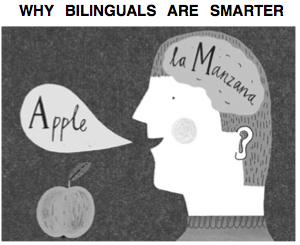
SPEAKING two languages rather than just one has obvious practical benefits in
an increasingly globalized world. But in recent years, scientists have begun to show
that the advantages of bilingualism are even more fundamental than being able to
converse with a wider range of people. Being bilingual, it turns out, makes you smarter.
5 – It can have a profound effect on your brain, improving cognitive skills not related to
language and even shielding against dementia in old age.
This view of bilingualism is remarkably different from the understanding of
bilingualism through much of the 20th century. Researchers, educators and policy
makers long considered a second language to be an interference, cognitively speaking,
10 – that hindered a child’s academic and intellectual development.
They were not wrong about the interference: there is ample evidence that in a
bilingual’s brain both language systems are active even when he is using only one
language, thus creating situations in which one system obstructs the other. But this
interference, researchers are finding out, isn’t so much a handicap as a blessing in
15 – disguise. It forces the brain to resolve internal conflict, giving the mind a workout that
strengthens its cognitive muscles.
The bilingual experience appears to influence the brain from infancy to old age
(and there is reason to believe that it may also apply to those who learn a second
language later in life). In a recent study of 44 elderly Spanish-English bilinguals,
20 – scientists led by the neuropsychologist Tamar Gollan of the University of California,
San Diego, found that individuals with a higher degree of bilingualism were more
resistant than others to the onset of dementia and other symptoms of Alzheimer’s
disease: the higher the degree of bilingualism, the later the age of onset.
BHATTACHARJEE, Y. Why bilinguals are smarter. Disponível em: <www.nytimes.com/2012/03/18/opinion/
sunday/the-benefits-of-bilingualism.html>. Acesso em: 21 set. 2012.
Complete the statements with the correct word or expression in parentheses.
a) “rather than” (l. 1) can be suitably replaced by ———————————————————————— (moreover/ instead of/ as well as)
b) “have begun” (l. 2) describes ———————————————————————————————————— (a present action connected with the past time/an action completed in the past/ an ongoing action in the present)
c) “thus” (l. 13) express—————————————————————————————— (condition/ contrast/ result)
d) “It” (l. 15) refers to —————————————————————— ( this interference/ a handicap / the brain)
e) “higher” (l. 21) is the opposite of————————————————————————— (louder/ shorter/ lower)
TEMPO NA QUESTÃO
 00:00:00
 Meu Desempenho
Inglês Interpretação de Texto
Total de Questões: ?
Respondidas: ? (0,00%)
Certas: ? (0,00%)
Erradas: ? (0,00%)
Somente usuários cadastrados!
 Estatísica da Questão
 Alternativa mais respondida
 Comentário dos estudantes